How AI Smart Glasses Are Transforming Work, Travel, and Daily Life
AI smart glasses are changing the way people work, travel, and manage everyday tasks. Explore how AI-powered wearables improve productivity, communication, navigation, accessibility, and convenience while shaping the future of hands-free technology.
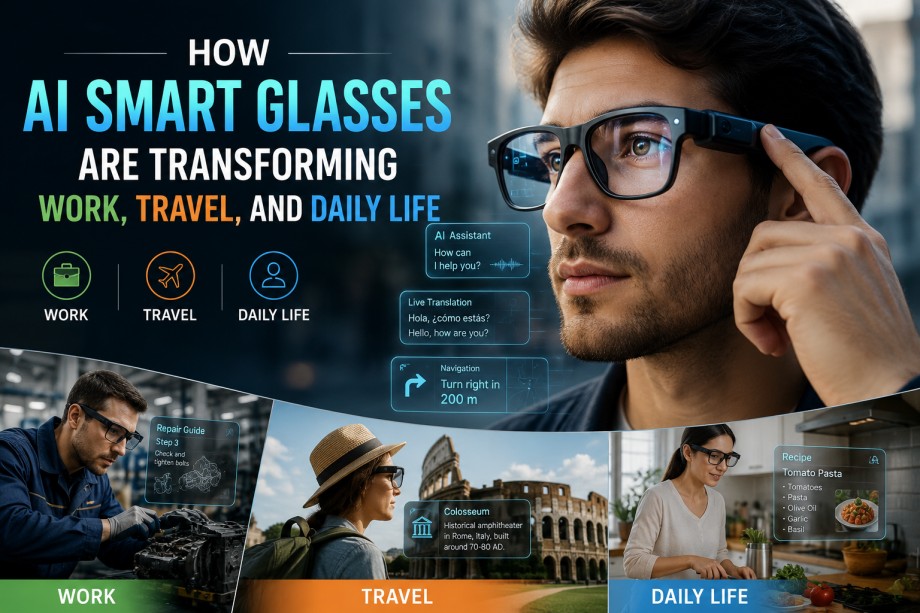
A few years ago, smart glasses felt like futuristic gadgets that belonged in science fiction. Today, they are becoming practical tools that help people work more efficiently, travel with greater confidence, and simplify everyday tasks. Thanks to rapid advances in artificial intelligence, these wearable devices are no longer limited to displaying notifications or taking photos. They can translate conversations, identify objects, summarize information, answer questions in real time, and even provide hands-free assistance while users stay focused on the world around them.
Unlike smartphones, which constantly demand attention through screens, AI smart glasses allow people to access information naturally without interrupting what they are doing. This shift is changing how professionals perform their jobs, how travelers explore unfamiliar places, and how individuals interact with technology throughout the day.
For users who require vision correction, many modern AI smart glasses can also be fitted with prescription lenses, allowing them to enjoy advanced technology without compromising clear vision. Whether you're using smart glasses for work, travel, or everyday activities, choosing the right prescription lenses ensures both comfort and optimal visual performance.
AI Brings a New Level of Intelligence to Wearable Technology
Traditional smart glasses mainly mirrored smartphone functions. AI-powered smart glasses go much further by understanding voice commands, recognizing images, interpreting surroundings, and responding intelligently to user requests.
Using built-in cameras, microphones, speakers, and cloud-based AI models, these glasses process information almost instantly. Instead of searching manually for answers, users simply ask questions naturally.
For example, someone can ask:
"Translate this menu into English."
"Summarize the meeting discussion."
"What landmark am I looking at?"
"Read this document aloud."
The glasses process visual and spoken information simultaneously, providing useful responses while allowing users to keep both hands free.
This combination of computer vision, speech recognition, and generative AI makes wearable technology significantly more practical than earlier generations.
Smarter Workplaces with Hands-Free Assistance
Many industries are adopting AI smart glasses because they improve productivity while reducing interruptions. Workers no longer need to stop what they are doing to check manuals, search for instructions, or make phone calls.
Manufacturing and Industrial Operations
Factory technicians often perform complex repairs where both hands are occupied. AI smart glasses can display step-by-step repair instructions directly within their field of view. They can also recognize equipment, identify parts, and provide maintenance guidance without requiring printed manuals.
Experienced engineers can even assist remotely by viewing exactly what the technician sees through the glasses' camera.
This reduces downtime, minimizes mistakes, and speeds up repairs.
Healthcare
Medical professionals benefit from instant access to patient information without turning away from patients. AI can summarize medical histories, display treatment notes, and assist with documentation through voice commands.
Some healthcare teams also use smart glasses for remote consultations, allowing specialists to observe procedures from another location.
Construction
Construction sites require constant awareness of surroundings. Instead of carrying blueprints everywhere, workers can access project plans, measurements, safety information, and inspection checklists through voice commands.
This improves efficiency while helping workers remain focused on their environment.
Warehousing and Logistics
Warehouse employees can receive picking instructions, inventory updates, and navigation guidance through AI smart glasses. This reduces time spent searching for products while increasing order accuracy.
The result is faster operations with fewer errors.
Business Professionals Gain More Freedom
Office workers are discovering that AI smart glasses can reduce dependence on laptops and phones during meetings.
Instead of taking handwritten notes, AI automatically creates meeting summaries, identifies action items, and organizes key discussion points.
During presentations, professionals can discreetly view reminders or talking points without looking away from their audience.
Sales representatives also benefit by accessing customer information before meetings while keeping conversations natural and engaging.
Rather than replacing computers, AI smart glasses complement existing workflows by removing repetitive tasks.
Travel Becomes Easier and Less Stressful
Travel often involves unfamiliar languages, confusing transportation systems, and unexpected situations. AI smart glasses help travelers navigate these challenges with greater confidence.
Instant Language Translation
One of the most impressive capabilities is real-time translation.
When someone speaks a foreign language, AI can translate the conversation almost instantly through the glasses. Text on menus, signs, airport displays, and restaurant boards can also be translated by simply looking at them.
This reduces communication barriers and makes international travel much more comfortable.
Navigation Without Constant Phone Use
Instead of repeatedly checking maps, travelers receive navigation directions through audio prompts or subtle visual guidance displayed inside the glasses.
Walking through busy streets becomes easier because users can stay aware of traffic, pedestrians, and surroundings.
Learning About New Places
Pointing the camera toward a monument, museum exhibit, or historic building allows AI to identify the location and provide interesting facts immediately.
Travel becomes more interactive without constantly searching online.
Making Everyday Life More Convenient
AI smart glasses are not only designed for professionals or travelers. Everyday users are discovering practical benefits throughout their daily routines.
While shopping, AI can compare products, read ingredient labels, or identify allergens.
When cooking, users can follow recipes without touching phones with messy hands.
Students can receive explanations for unfamiliar concepts while studying printed materials.
Parents can quickly capture family moments through voice commands instead of reaching for a smartphone.
Even simple tasks like checking the weather, setting reminders, or responding to messages become more convenient when performed hands-free.
Accessibility Improvements for More Independent Living
Perhaps one of the most meaningful applications of AI smart glasses is improving accessibility.
People with visual impairments can use AI to describe surroundings, recognize faces, identify currency, read printed text aloud, and detect nearby objects.
For individuals with hearing difficulties, real-time speech transcription can convert conversations into readable captions.
These capabilities help many users perform daily activities more independently while increasing confidence in unfamiliar environments.
As AI continues improving, accessibility features are expected to become even more accurate and responsive.
Education Without Boundaries
Learning becomes more engaging when information appears exactly when needed.
Students wearing AI smart glasses can receive explanations of diagrams, translate educational content, identify scientific specimens, or ask follow-up questions without interrupting lessons.
Teachers may eventually use smart glasses to create interactive classroom experiences where digital content blends naturally with physical learning materials.
Instead of replacing traditional education, AI becomes an intelligent learning assistant.
Privacy and Security Remain Important
Despite their growing capabilities, AI smart glasses raise understandable privacy concerns.
Built-in cameras and microphones collect large amounts of information, making responsible use essential.
Manufacturers continue improving privacy features such as recording indicators, user permission controls, encrypted data transmission, and local AI processing.
Organizations adopting AI smart glasses should establish clear policies regarding recording, data storage, and employee privacy.
Consumers should also understand how their information is processed before choosing a device.
Responsible innovation will play a major role in public acceptance.
Current Limitations Users Should Consider
Although AI smart glasses have advanced significantly, they are not perfect.
Battery life remains shorter than many users would like, especially when AI features are used continuously.
Some advanced capabilities require reliable internet connections for cloud-based processing.
Voice recognition may occasionally struggle in noisy environments, while image recognition accuracy can vary depending on lighting conditions.
Cost also remains a barrier for premium AI smart glasses, although prices are gradually becoming more affordable as competition increases.
Thinking about buying AI smart glasses? Before choosing a model, it helps to understand factors such as battery life, prescription lens compatibility, privacy features, and real-world usability. Read our complete buyer’s guide: AI Smart Glasses in 2026: Everything Houston Consumers Need to Know Before Buying.
What the Future Looks Like
The next generation of AI smart glasses is expected to become smaller, lighter, and considerably more powerful.
Future improvements may include:
Longer battery life
Better augmented reality displays
Faster on-device AI processing
More natural voice conversations
Enhanced object recognition
Improved health monitoring
Personalized digital assistants that understand user preferences
As artificial intelligence continues evolving, smart glasses will likely become one of the most useful personal computing devices people wear every day.
A New Way to Interact with Technology
AI smart glasses represent more than another consumer gadget—they introduce a different way of interacting with information. Instead of constantly shifting attention between the physical world and a smartphone screen, users receive timely assistance while staying engaged with the people and environments around them.
From helping technicians complete complex repairs and enabling professionals to work more efficiently to making international travel less intimidating and supporting individuals with accessibility needs, these wearable devices are finding practical uses across many aspects of life. While challenges such as battery life, privacy, and affordability remain, ongoing innovation is steadily addressing these limitations.
As AI becomes faster, more accurate, and increasingly integrated into wearable technology, smart glasses are poised to become everyday companions that enhance productivity, communication, learning, and convenience without demanding our constant attention.


.webp)
.webp)