Prescription Smart Glasses: Features, Benefits & Limitations
Discover whether prescription smart glasses are right for you. Learn how they work, their features, benefits, limitations, compatibility with prescription lenses, and what to consider before buying smart eyewear.
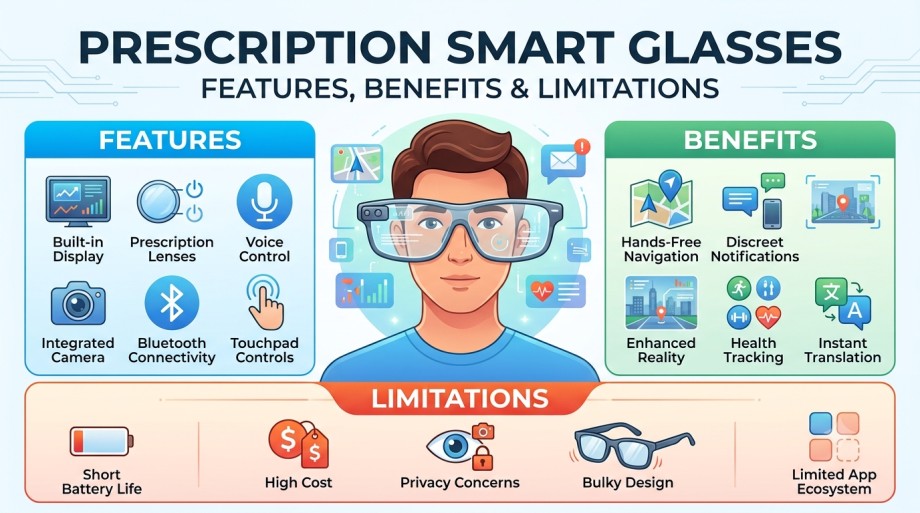
Not long ago, smart glasses felt like something reserved for science fiction. Today, they're finding their place in everyday life. Whether you're answering calls without reaching for your phone, getting navigation directions while walking, or listening to music through open-ear speakers, smart glasses have evolved into practical wearable technology.
For people who already wear prescription eyewear, however, one question comes up almost immediately: Can smart glasses be made with prescription lenses?
The answer is yes—but it isn't always as straightforward as replacing the lenses in a regular pair of glasses. Compatibility, lens technology, frame design, and cost all play a role in determining whether prescription smart glasses are the right choice.
Understanding what they can and cannot do helps you choose a pair that fits both your vision needs and your lifestyle.
What Are Prescription Smart Glasses?
Prescription smart glasses combine corrective vision with built-in electronic features. Instead of carrying separate prescription glasses and wearable devices, users get both functions in a single frame.
Depending on the model, smart glasses may include:
Bluetooth connectivity
Integrated speakers
Voice assistants
Touch controls
Cameras
Microphones
Fitness tracking
Augmented reality (AR) displays
Navigation assistance
The prescription lenses work just like those found in conventional eyeglasses, correcting nearsightedness, farsightedness, astigmatism, or presbyopia while the technology operates independently within the frame.
The result is a wearable device that improves vision while adding digital convenience throughout the day.
How Prescription Lenses Work with Smart Glasses
Unlike ordinary eyewear, smart glasses contain electronics embedded inside the temples or frame. Batteries, speakers, microphones, sensors, and circuit boards require careful engineering.
Fortunately, most modern manufacturers design their frames to accept prescription lenses.
There are generally three ways users obtain prescription smart glasses:
Factory-installed prescription lenses
Many brands partner with optical labs that install custom prescription lenses before shipping the glasses.
Authorized optical retailers
Some smart glasses are sold through optical stores where licensed professionals fit prescription lenses into compatible frames.
Lens replacement after purchase
Certain models allow opticians to replace the original plano lenses with prescription lenses after purchase.
Not every smart frame supports every prescription. Strong prescriptions, thick lenses, or specialized lens shapes may have limitations depending on the frame design.
Features That Make Prescription Smart Glasses Different
The appeal of smart glasses extends far beyond correcting eyesight.
Wireless Audio Without Earbuds
Open-ear speakers direct sound toward your ears while leaving them uncovered.
This allows users to:
Listen to podcasts
Take phone calls
Join virtual meetings
Hear GPS directions
Enjoy music
Unlike headphones, users remain aware of surrounding traffic, conversations, and environmental sounds.
Hands-Free Voice Control
Many smart glasses integrate with voice assistants.
Instead of pulling out a smartphone, users can ask for weather updates, set reminders, send messages, or control smart home devices using voice commands.
This convenience is especially valuable while walking, cycling, or multitasking.
Built-In Cameras
Some premium smart glasses include discreet cameras capable of capturing:
Photos
Short videos
Livestreams
Content creators, travelers, and professionals often appreciate recording moments from a first-person perspective.
Navigation Assistance
Certain models provide spoken directions or subtle visual guidance.
Instead of constantly checking a smartphone screen, users receive navigation assistance naturally while keeping their eyes focused ahead.
Notifications
Smart glasses can quietly alert users about:
Incoming calls
Text messages
Calendar reminders
App notifications
This reduces the need to repeatedly check a phone throughout the day.
Augmented Reality Displays
High-end smart glasses project digital information into the user's field of view.
Examples include:
Navigation arrows
Translation text
Work instructions
Virtual monitors
Real-time data
AR remains a premium feature but continues improving with newer generations.
Who Benefits Most from Prescription Smart Glasses?
These glasses aren't designed for everyone equally. Certain users gain far greater value from the technology.
Professionals
Employees who spend much of the day communicating benefit from easy access to calls and notifications without interrupting their workflow.
Remote Workers
Video meetings, voice communication, reminders, and productivity tools become more accessible while maintaining visual comfort.
Travelers
Navigation, language assistance, photography, and hands-free communication simplify exploring unfamiliar places.
Fitness Enthusiasts
Walkers, cyclists, and runners appreciate listening to audio while maintaining awareness of their surroundings.
Students
Voice notes, reminders, calendar alerts, and educational audio become available without carrying additional devices.
Benefits Beyond Convenience
Prescription smart glasses offer more than simply combining two products.
One Device Instead of Two
Users who already wear prescription glasses no longer need to alternate between corrective eyewear and wearable technology.
Everything stays in one comfortable frame.
Less Screen Time
Checking notifications through voice prompts or audio reduces unnecessary smartphone use throughout the day.
Many users find themselves reaching for their phones less often.
Improved Productivity
Quick access to calls, reminders, schedules, and voice commands helps users stay organized without disrupting ongoing tasks.
Small time savings accumulate throughout busy workdays.
Better Situational Awareness
Unlike earbuds that block surrounding sounds, open-ear audio keeps environmental awareness intact.
This is particularly useful while walking in busy cities or commuting.
Everyday Comfort
Rather than carrying multiple devices, users simply wear their prescription glasses as they normally would.
The technology blends into daily routines instead of creating additional steps.
The Limitations You Should Know
Smart glasses are impressive, but they still involve compromises.
Battery Life
Most smart glasses require regular charging.
Heavy use involving music, calls, or cameras shortens battery life considerably.
Unlike standard glasses, they cannot simply be worn indefinitely without power management.
Higher Cost
Prescription lenses increase the total investment.
Depending on features and prescription complexity, costs can become significantly higher than traditional eyeglasses.
Prescription Restrictions
Very strong prescriptions may not work with every frame.
High-index lenses, prism corrections, or unusually thick lenses sometimes exceed manufacturer recommendations.
Consulting an optical professional before purchasing helps avoid compatibility issues.
Limited Frame Choices
Traditional eyewear comes in thousands of styles.
Smart glasses currently offer a much smaller selection because technology requires specific frame dimensions.
Fashion-conscious buyers may find fewer options than expected.
Technology Obsolescence
Prescription glasses often last several years.
Consumer electronics evolve much faster.
A smart frame purchased today could feel outdated long before the prescription itself changes.
Repairs Can Be More Complicated
If electronic components fail, repairs typically involve specialized service rather than a simple optical adjustment.
Water damage or battery issues may require manufacturer support.
Choosing the Right Prescription Smart Glasses
Before making a purchase, think beyond the technology itself.
If you're comparing the latest wearable technology before making a decision, you may also find our guide on AI smart glasses in 2026 and what buyers should know before purchasing helpful, especially if you're evaluating different features, frame options, and real-world use cases.
Ask yourself:
Is the frame compatible with your prescription?
Will your optician install custom lenses?
Does the battery life fit your daily routine?
Which smart features will you actually use?
Are replacement parts available?
Is the frame comfortable for all-day wear?
Does it support lens coatings like anti-reflective, photochromic, or blue-light filtering?
The most expensive model isn't necessarily the best choice if most of its features go unused.
Matching your daily habits with the available technology usually leads to greater satisfaction.
Are Prescription Smart Glasses Worth It?
The answer depends on how much value you place on connected technology.
For someone who simply needs vision correction, traditional prescription glasses remain lighter, less expensive, and easier to maintain.
For people who frequently answer calls, rely on navigation, listen to audio throughout the day, or appreciate hands-free convenience, prescription smart glasses can replace multiple devices while streamlining everyday tasks.
As battery technology, augmented reality, and wearable computing continue advancing, prescription smart glasses are becoming increasingly practical rather than experimental.
Instead of asking whether prescription smart glasses exist, many consumers are now asking which model best matches their lifestyle. That shift reflects how wearable technology has matured from an interesting concept into a realistic option for everyday vision correction.
The key is balancing expectations. Smart glasses enhance convenience, communication, and accessibility, but they are not a complete replacement for smartphones, laptops, or specialized professional equipment. Choosing a model that supports your prescription, fits comfortably, and includes features you'll genuinely use is far more important than chasing every new capability. When selected thoughtfully, prescription smart glasses can become one of the most versatile pieces of technology you wear every day.

.webp)
.webp)