Smart Glasses vs Traditional Eyeglasses: Which Option Is Better in 2026?
Smart glasses are changing the eyewear industry by combining vision correction with advanced technology, while traditional eyeglasses remain the preferred choice for comfort, affordability, and everyday vision needs. This guide compares smart glasses and traditional eyeglasses in 2026, exploring their features, costs, comfort levels, privacy concerns, and practical benefits. Whether you're considering wearable technology or looking for reliable prescription eyewear, this comparison will help you determine which option best fits your lifestyle.
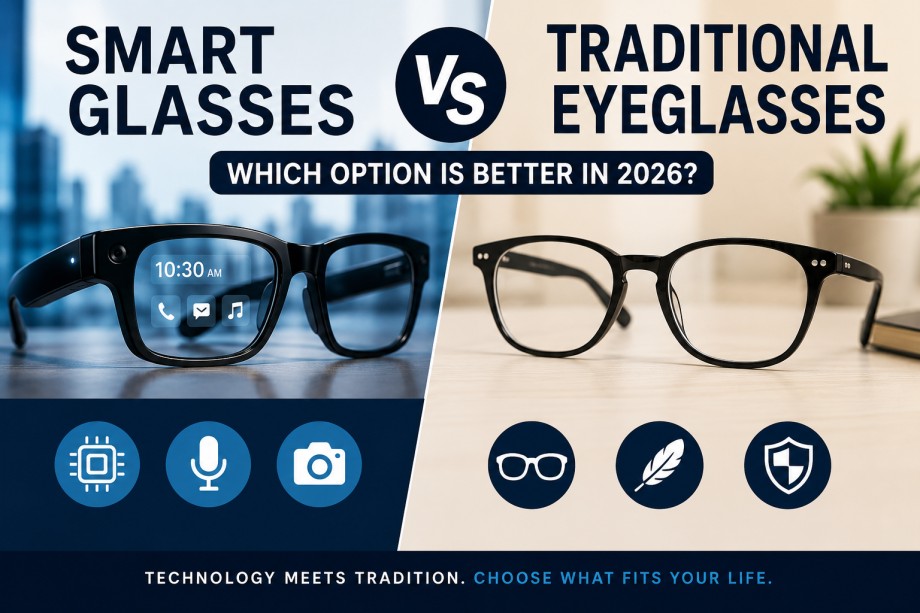
A few years ago, smart glasses felt like a futuristic gadget that belonged in science fiction movies. In 2026, they're sitting on store shelves next to traditional eyeglasses, competing for space on consumers' faces and in their wallets.
For someone shopping for everyday eyewear, the decision can feel surprisingly complicated. Do you choose a pair of glasses that simply helps you see clearly, or invest in eyewear that can take calls, play music, provide notifications, and interact with digital assistants?
The answer depends less on technology and more on how you live your daily life.
The Purpose of Eyeglasses Has Changed
For decades, eyeglasses served a straightforward purpose: vision correction.
Whether you wore reading glasses to enjoy a novel, prescription eyeglasses for driving, or progressive lenses for all-day clarity, glasses were primarily medical devices with a fashion component.
Smart glasses introduce an entirely different concept. They combine vision support with connected technology, turning eyewear into a wearable device.
Instead of asking, "Can I see clearly?" consumers now ask questions like:
Can I answer calls hands-free?
Can I listen to podcasts without earbuds?
Can I access navigation while walking?
Is it possible for me to remain connected without always looking at my phone?
This shift is creating two distinct categories of eyewear rather than replacing one with the other.
What Smart Glasses Actually Do
Many people still imagine bulky, awkward devices when they hear the term smart glasses.
Modern models look surprisingly similar to traditional frames. The technology is often hidden inside the temples, allowing users to enjoy features such as:
Bluetooth connectivity
Voice assistant integration
Hands-free phone calls
Audio streaming
Camera functionality on select models
Real-time notifications
Navigation support
As smart eyewear technology continues to evolve, consumers are becoming increasingly interested in how AI-powered features can enhance everyday life. If you're considering wearable technology, our guide on AI Smart Glasses in 2026: Everything Houston Consumers Need to Know Before Buying provides a deeper look at the latest innovations, benefits, and buying considerations.
For tech enthusiasts, this creates an experience that traditional glasses simply cannot offer.
However, more features don't automatically mean a better experience for everyone.
Why Traditional Eyeglasses Still Dominate
Despite the growing attention around wearable technology, traditional eyeglasses remain the preferred choice for millions of Americans.
There's a simple reason for that.
Most people buy glasses because they need to see better.
Traditional eyewear focuses entirely on visual performance. The lenses are lighter, the frames are often more affordable, and there is no need to charge a battery every night.
When someone spends eight to twelve hours wearing glasses every day, comfort becomes more important than technology.
A lightweight pair of prescription eyeglasses can easily outlast several generations of electronic devices.
While smartphones become outdated every few years, a quality pair of glasses can remain useful much longer.
The Comfort Factor
Comfort is often overlooked when comparing eyewear options.
Smart glasses contain electronics, speakers, batteries, sensors, and connectivity components. Even with advances in miniaturization, this additional hardware can add weight.
Traditional eyeglasses are generally lighter and simpler.
For people who wear glasses from morning until bedtime, even a small difference in weight becomes noticeable after several hours.
This is especially important for:
Office workers
Students
Frequent readers
Seniors
Individuals with strong prescriptions
When vision correction is the primary goal, traditional frames often provide a more comfortable long-term experience.
Battery Life Changes Everything
One major difference separates smart glasses from ordinary eyewear.
Traditional glasses never run out of power.
Smart glasses do.
Imagine leaving home for an important meeting only to discover your smart glasses have a depleted battery. The eyewear still functions physically, but many of the features that justified the higher price disappear instantly.
Traditional eyeglasses eliminate this concern completely.
There is no charging cable, battery indicator, software update, or connectivity issue to worry about.
For consumers who value simplicity, that reliability remains a significant advantage.
Cost Comparison in 2026
Price continues to influence buying decisions.
Traditional eyeglasses are available across nearly every budget range. Consumers can find affordable reading glasses, mid-range prescription eyewear, and premium designer frames.
Smart glasses generally command higher prices because they combine eyewear and technology into a single product.
Beyond the initial purchase, users may also face future expenses related to:
Battery degradation
Software support
Repairs
Hardware upgrades
Technology products naturally age faster than conventional eyewear.
A pair of prescription glasses purchased today may still feel current years later. Smart glasses, however, can become outdated as newer models introduce improved features.
Privacy Concerns Continue to Grow
Privacy has become one of the most discussed topics surrounding wearable technology.
Traditional eyeglasses are straightforward. People understand their purpose immediately.
Smart glasses equipped with cameras, microphones, and connectivity features create additional concerns.
People around the wearer may not always know when recording capabilities are active.
As technology becomes more integrated into daily life, consumers increasingly weigh convenience against privacy.
For some users, smart functionality is worth the tradeoff.
Others prefer the simplicity and transparency of conventional eyewear.
The Best Choice for Reading and Work
Reading remains one area where traditional glasses maintain a strong advantage.
People who spend hours reading books, reviewing documents, or working on computers typically prioritize:
Optical clarity
Lens quality
Comfort
Reduced eye strain
A dedicated pair of reading eyeglasses is designed specifically for these tasks.
Smart glasses may offer productivity tools, but they don't necessarily improve the reading experience itself.
For professionals, students, and retirees who regularly read printed material, traditional reading glasses continue to provide exceptional value.
Fashion Still Matters
Eyewear has become one of the most visible personal accessories people wear.
Traditional eyeglasses offer nearly unlimited design options:
Minimalist metal frames
Bold acetate styles
Retro-inspired shapes
Contemporary designer collections
Smart glasses are improving aesthetically, but technology still places certain design limitations on frame construction.
Consumers focused on fashion often appreciate the broader variety available in traditional eyewear.
The ability to select frames purely for appearance remains an advantage that conventional glasses continue to hold.
Who Should Buy Smart Glasses?
Smart glasses make sense for individuals who:
Frequently take calls while moving
Enjoy wearable technology
Listen to audio throughout the day
Want hands-free digital assistance
Value convenience over simplicity
For these users, smart eyewear can reduce dependence on phones and earbuds while adding useful functionality.
The technology has matured significantly and now delivers practical benefits that extend beyond novelty.
Who Should Stick With Traditional Eyeglasses?
Traditional eyewear remains the better choice for people who prioritize:
Vision correction
Long-term comfort
Lower costs
Reliability
Reading performance
Lightweight frames
For the average consumer seeking clear vision and everyday wearability, traditional glasses still offer the most practical solution.
The Verdict for 2026
Smart glasses are no longer experimental gadgets. They're becoming legitimate tools for communication, productivity, and entertainment.
Yet their rise doesn't signal the end of traditional eyeglasses.
Instead, the market is evolving into two separate categories.
Smart glasses serve people who want technology integrated into daily life. Traditional eyeglasses continue serving those who want dependable vision correction without added complexity.
In 2026, the better option isn't determined by innovation alone.
It's determined by your priorities.
If your goal is staying connected, smart glasses may be worth exploring.
If your goal is seeing clearly, comfortably, and affordably every day, traditional eyeglasses remain difficult to beat.
.webp)
.webp)